ユウタ フィノリクシ AI-Powered Trading Automation for Skill Building
ユウタ フィノリクシ presents a premium look into the automation workflows shaping contemporary trading education, highlighting disciplined setup and repeatable execution patterns. The material explains how AI-driven trading guidance can aid supervision, parameter management, and rule-based decision making across varying market environments. Each segment spotlights practical elements students and practitioners assess when exploring automated trading bots for suitability and learning value.
- Well-structured modules for automation sequences and governing rules.
- Adjustable limits for risk, sizing, and session behavior.
- Clear operations with transparent status and audit trails.
Join the platform
Provide details to begin your account journey and access AI-assisted trading education resources.
Key capabilities showcased by ユウタ フィノリクシ
ユウタ フィノリクシ outlines principal components linked with automated learning tools and AI-powered guidance, focusing on structured functionality and clear operational insight. The section explains how automation modules can be arranged for dependable execution, steady monitoring, and governance of parameters. Each card highlights a practical capability area commonly reviewed by learners and professionals evaluating automated trading solutions.
Automation step orchestration
Outlines how automation stages are ordered—from data intake through rule checks to trade routing—cultivating reliable behavior session over session and enabling repeatable evaluation.
- Modular stages and smooth handoffs
- Strategy rule grouping
- Traceable execution steps
AI-guided support layer
Explains how AI components assist pattern recognition, parameter management, and workflow prioritization. The approach emphasizes disciplined guidance aligned with defined limits.
- Pattern processing routines
- Parameter-aware guidance
- Status-driven monitoring
Run-time governance controls
Summarizes essential control surfaces used to shape automation behavior—exposure, sizing, and session constraints—supporting consistent governance across bot workflows.
- Exposure limits
- Position sizing rules
- Session windows
How the ユウタ フィノリクシ workflow is commonly organized
This practical overview presents an operations-first sequence aligned with how automated learning tools are typically configured and supervised. The steps show how AI-assisted guidance integrates with monitoring and parameter handling while execution follows defined rule sets. The layout makes it easy to compare process stages at a glance.
Data ingestion and standardization
Automation workflows begin with structured market data preparation so downstream rules operate on uniform formats, enabling stable processing across instruments and venues.
Rule evaluation and constraints
Strategy rules and constraints are assessed together so execution logic stays aligned with predefined parameters, including sizing rules and exposure boundaries.
Order routing and lifecycle tracking
When criteria are met, orders move through an execution lifecycle with traceable tracking for review and follow-up actions.
Monitoring and optimization
AI-assisted guidance supports ongoing monitoring and parameter review, helping sustain a consistent operational posture with clear governance.
FAQ about ユウタ フィノリクシ
These questions summarize how ユウタ フィノリクシ explains automated learning tools, AI-guided assistance, and structured workflows. The answers emphasize scope, configuration concepts, and common steps in an education-focused automation environment. Each item is crafted for quick scanning and easy comparison.
What areas does ユウタ フィノリクシ cover?
ユウタ フィノリクシ presents organized information about automation workflows, execution components, and governance concepts used with automated trading simulations. The content highlights AI-guided education concepts for monitoring, parameter handling, and governance routines.
How are automation boundaries defined?
Automation boundaries are described through exposure limits, sizing rules, session windows, and protective thresholds to support consistent execution aligned with user-defined parameters.
Where does AI-powered trading assistance fit?
AI-powered trading assistance is typically presented as support for structured monitoring, pattern processing, and parameter-aware workflows, promoting consistent routines across automation stages.
What happens after submitting the registration form?
After submission, details are routed for account follow-up and setup steps that align with automation education requirements, including verification and structured onboarding.
How is information organized for quick review?
ユウタ フィノリクシ uses sectioned summaries, numbered capability cards, and step grids to present topics clearly, supporting efficient comparison of automated learning tools and AI-guided workflows.
From overview to hands-on access with ユウタ フィノリクシ
Utilize the registration panel to initiate an onboarding path tailored to automation-first learning. The content outlines how AI-assisted trading education tools are structured to support consistent execution and practical skill development.
Risk management tips for automation workflows
This section summarizes practical risk-control concepts commonly paired with automated trading bots and AI-powered trading assistance. The tips emphasize structured boundaries and consistent operational routines that can be configured as part of an execution workflow. Each expandable item highlights a distinct control area for clear review.
Define exposure boundaries
Exposure boundaries typically describe how much capital allocation and open position limits are permitted within an automated trading bot workflow. Clear boundaries support consistent execution behavior across sessions and support structured monitoring routines.
Standardize order sizing rules
Order sizing rules can be expressed as fixed units, percentage-based sizing, or constraint-based sizing tied to volatility and exposure. This organization supports repeatable behavior and clear review when AI-guided monitoring is used.
Use session windows and cadence
Session windows define when automation routines run and how frequently checks occur. A consistent cadence supports stable operations and aligns monitoring workflows with defined execution schedules.
Maintain review checkpoints
Review checkpoints typically include configuration validation, parameter confirmation, and operational status summaries. This structure supports clear governance around automated trading bots and AI-powered trading assistance routines.
Align controls before activation
ユウタ フィノリクシ frames risk handling as a structured set of boundaries and review routines that integrate into automation workflows. This approach supports consistent operations and clear parameter governance across execution stages.
Security and operational safeguards
ユウタ フィノリクシ highlights core safeguards used across automation-focused learning environments. The items emphasize structured data handling, controlled access, and integrity-oriented operational practices. The goal is a clear presentation of protections that accompany AI-guided trading education workflows.
Data protection practices
Security concepts include encryption in transit and careful handling of sensitive fields. These practices support reliable processing across account workflows.
Access governance
Access governance involves structured verification steps and role-aware account management. This supports orderly operations aligned to automation workflows.
Operational integrity
Integrity practices emphasize consistent logging and structured review checkpoints. These patterns support clear oversight when automation routines are active.
Disclaimer
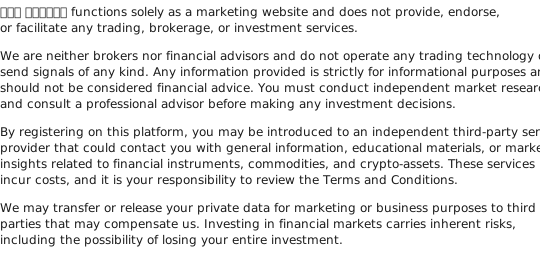
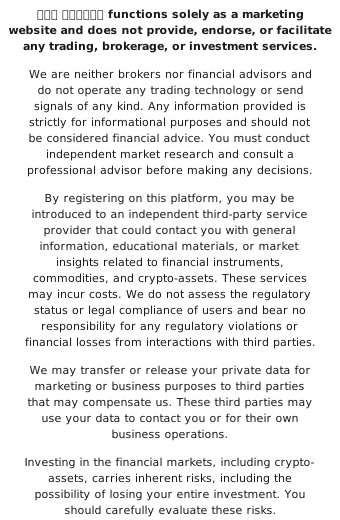
This website functions solely as a marketing platform and does not provide, endorse, or facilitate any trading, brokerage, or investment services.
Read More